Imagining Crisis-Contemporary Aesthetics of
Memento Mori
Yunnia Yang
(Taiwanese Art Journal ’Art
Collection+Design’ , October 2014;
devoted to the focal theme ’Metamorphosis)
Life is
complete for including death in itself. However, the viewpoint on death in the
East differs from the one in the West. In the East, people avoid death as
taboo, which may trigger many unfortunate omens or associations. In the Western
Christianity, death is regarded as a kind of salvation. In the Medieval period,
wars occurred frequently and the Black Death prevailed all over Europe, so the contemporaries transcended the fear of death
through the carnivalesque ‘Dance Macabre’. The Renaissance artists, such as
Hieronymus Bosch, Pieter Bruegel the
Elder, deal the topic of death with sarcastic humor. There are full of
mystic symbols of intertwining life and death in the works of Albrecht Dürer,
Hans Holbein the Younger,el Greco, and the Dutch paintings of the Golden Age,
inspiring the contemporaries to live in the present.Even living in the 21st
century, we cannot free ourselves from the fear of death because of the
advanced civilization,but the disasters and crises caused by the technology
accelerate the death of all the creatures instead.In the treatise‘The
Aesthetics of Disappearance’, the
French cultural theorist Paul Virilio gives us his transcendental insight into
the modern civilization under which the human beings pursue everything
efficiently and speedily, so that time waits no man to experience life rather than disappearance.
The inventions under the Industrial Revolution may cause the unprecedented new
disasters, such as car, train, ship and aviation accidents, seeding the living
environment into numerous unexploded mines.
Ubiquitous causes of death deepen the uncertainty of being. Material
desire perhaps reflects the fear and turmoil lurking deeply inside the human
mind. Driven by the ‘Death
Instinct’, this imagination is an
expression of creativity for an artist, as well as a contemporary memento mori.
It deconstructs the given aesthetics. The International Creative Exhibition
'Imagining Crisis' has been presented at the Museum of Contemporary Art in Taipei from September 15 till October 14, 2014.
This video project has toured around the contemporary art centers in Poland,
Serbia and Bulgaria. The Taiwanese curator Yunnia Yang invited 10 artists, 11
videos from Asia, Europe and Latin America to join this project, including
experimental films, videodances, stop motions, etc. 'Imagining Crisis' departs
from the anxieties of the artists about the artistic creation and the art
world, our society twisting the essence of an individual very much through all
kinds of mass media (including religion), and the nature pouncing on human
beings for their long-term destruction. From the concrete perceptible crisis to
the invisible, metaphysical, imaginative crisis, these creative artists embody
the eccentric aesthetics of imagining the death.
Allegorizing the Dilemma
of Contemporary
Art Development with Humor
For artists,
the most crucial crisis is that contemporary art is hard to approach the
general public. The marginalization of contemporary art affects the creating
and living condition of an artist. The global financial crash worsens this
situation, for the governments all over the world precondition to satisfy the
basic needs and reduce the budget in arts and cultures. The Spanish artist
Albert Merino creates a fictitious
’Contemporary Art Festival’, transforming the outdoor public space of
Paris completely into an energetic and enchanted museum, and bringing art
closer to the public. The artist expects art becomes a means of communication,
fulfilling the Utopian mission of improving society. Merino creates his own
visual aesthetics in a surrealist style and constructs a documentary-like text
humorously, but the audience can perceive the real crisis of acceptability of
contemporary art in such a fiction. In his video, Merino proposes several
original concepts, such as ‘Art recycling’, ‘Hotel Paradise’, ‘Pleasure Machine’,
‘Utopia’, referring to the change of the aesthetics and art materials of this
new generation, the authority’s interference
in the art creations related to social engagement, and the unspeakable esotericism
of contemporary art. The public misunderstands the Utopian social practices
artists make are actions to disturb the public life. The urban transformation
looks seemingly an absurd daydream, but artists confront these difficulties of
contemporary art development everyday instead. The Israeli artist Marcus Shahar
emphasizes the deification of ‘The Curator’ in the art world; the mass media
fetishizes a curator as a superstar. Shahar employs the form of a Hollywood
trailer, playing the role of ‘The Curator’ himself to proclaim the ‘inauguration’
of a curator sarcastically. Shahar intends to track the behavior of the curator
and his multiple identities, mapping the external signs and cultural codes,
thinking over the must-haves in such an aspirational position, analyzing the mechanism
of self-glorification and the secret of success in predominating art,
criticizing the superficiality in some aspects of the art world. This world may
include the ‘celebrity’ culture filled with compliments and imitations, as well
as flood the corporate sponsors expecting to enhance the social reputations by
means of the artworks and artists.
1. Contemporary Art Festival. Albert Merino (Spain)
2011. 20 min. 20 sec.
2. The Curator. Shahar Marcus(Israel)
2011. 4 min. 35 min.
The Revelation of Progressive Civilization
Going through the Feminism in the 1980s, we can
observe that the social status of women has been raised in general; however,
the mass media dominates the pop culture and the consumption behavior so much
that the public takes female images as a tool of seduction for granted,
overemphasizing the importance of beauty, burdening oneself physically and
psychically with the ideal beauty. The public opinion kidnaps the free will of
a human being, as if viruses spread all over one’s body. Born of an extremely
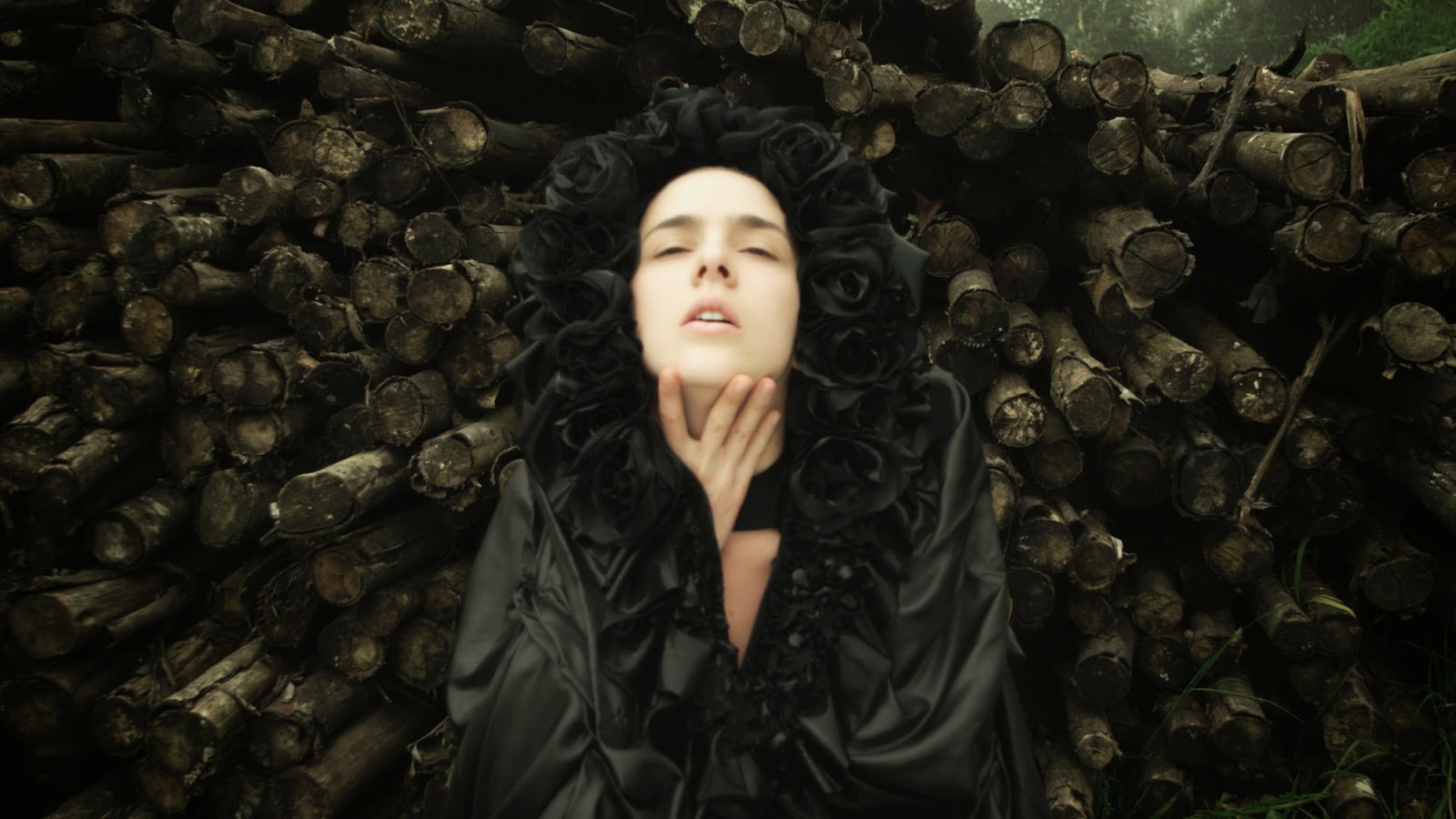
conservative society, the Colombian artist Rossina Bossio creates
her videodance ‘The Holy Beauty Project Volume III’
with the interdisciplinary exploration of body, dance and fashion to examine
the seductive power of visual culture. The media uses female images as a
communication tool to strengthen social order and set up a perfect example of
beauty and morality. Bossio plays eight different roles in her video,
representing the different characters of female identity. With the epic background
music, the protagonist dances in the rain forest, in the studio from time to
time, dressing the costume from the Christian icon, the outfit from the
aboriginals of the Americas and the clothes of a contemporary woman. The
choreography changes the stereotyped movements of female sexuality; the divine
but violent movements can be seen in commercials, MTV and fashion world. The most impressed image is the luxurious
image of Santa Maria that Bossio transforms herself into. She holds a Barbie
doll of Santa Maria, dancing mechanically like a robot. This image is
emphasized the feet
proportion of the distorted body. The tears Santa Maria sheds hint that women
suffer from social prejudices involuntarily. The duality of pure Santa Maria
and the playful Barbie dolls alienates the essence of being, and also makes
irony of the permanent necessity of idols and deities in a civilized
society.
3. The Holy Beauty Project Volume III.
Rossina Bossio(Colombia).2012. 6 min. 26 min.
The concerns about the
global warming have been the common efforts of the entire world. Accustomed to
the convenience of technological civilization, it is
easier said than done to enforce the low-carbon life completely. Argentina, situated near the Antarctic,
witnesses the glaciers are collapsing so rapidly that the sea level keeps on rising. This shocking phenomenon
affects the existence of human beings strongly like a domino effect. The dance
video 'Efimero Festin' collaborated by the theatre director Ernesto Pombo and the
choreographer Chimene Costa is commissioned by the National Directorate of
Antarctica in Argentina , in order to explore the selfishness of human beings'
exploiting the Nature merely for material wealth and to awaken the crisis consciousness
of destructing the Nature. In the film,
the image of a woman holding red balloons symbolizes the self-destructing human
beings; she attempts to occupy the whole environment. Taking a look back at the
biological history of the Earth, human beings may disappear soon after dinosaurs
are extinct. For how long human beings will survive depends on how to protect
the Earth. The first half of the film presents a different sonic
scene of the Antarctica; the empty, isolated but endless area conveys dreamy
experience, like in another planet. As the female dancer desires to manipulate
the environment, the music is getting stronger in a threatening sense. The
imagery grammar of the film is the integration of the scenes from daily life,
local landscape and the climate change by means of close-ups and wide-angle
lens. The body language of the dancer embodies the struggle against the cruel
coldness of the environment through her manipulation upon different objects.
Eventually, she cannot survive under the counterforce of the Nature.
4.Efímero Festín. 2013. 8 min. 20 sec.
Ernesto Pombo&Chimene Costa(Argentina)
The
powerlessness to the reality is the common perception of the contemporaries:
wording hard for money day after day, enduring the setback during this economic
crisis, or accepting the simulated life by the media and technology. Like the destiny of ‘The Lost Generation’
after WWI and ‘The Beat Generation’ after WWII,
the new generation of the 21st
century is running like in a squirrel-cage rotor and escaping to
nowhere, trapped into another swamp called ‘ Dumbing Generation’. Regarding boringness as a fashionable lifestyle,
they indulge themselves with internet surfing, playing video games, watching
TV, listening to music, in order to kill the time. How can they manage
themselves in this drastically changing world with such negative living
attitude? In the video work ‘Confusion’, the Russian
art group ‘Provmyza’ warns symbolically that the zeitgeist of this century is the lack of
moral values and judgments. The film begins with the scene of a shaking crystal
chandelier, then a kind of inexplicably strange ambient spreads all over among
the party of the young people, recalling some kind of ambiguous, curious,
fearful, even confusing perceptions. This mysterious ambient becomes so
stronger that the young girls cannot help but fainting. Their vertigo looks like
a long performance. As time goes by, the scene remains the same and time
freezes human flesh into a sculpture. The boys’ confusion transforms into
aggression for being infected by a withered bush. The luxurious, meaningless
lifestyle is the self-destruction driven by the death instinct. The life value
is that the life instinct is evenly matched with the death instinct. In the
Freudian theory, the life instinct represents the instinct to continue and
extend the existence of a being, a libido to love oneself and others. In the dance
film ‘Ant’, the Finnish artist Kimmo Alakunnas shows that a workaholic, numb with the reality, intends to resist the regular
boringness of his mechanized life. Juxtaposing the images of the tied-up naked
flesh with ropes, Alakunnas implies the true self of the workaholic,
whose breathing sounds prove his own existence for getting rid of the
constraint. It is also questionable whether he regains the ability to love
someone owing to the numbness deep down in his heart, or he enforces his love
on someone to get hurt and hurt the other. What is the mysterious ant,
disturbing the protagonist? ‘Ant’ guides
viewers to think over the life meaning by means of dance and movement. Without
narratives, viewers can give their own interpretations freely based on their
own life experiences.
5. Confusion. Provmyza(Russia)
2009. 12 min. 16 sec.
6. Ant. Kimmo Alakunnas(Finland)
2010.24 min.
The Experimental Adventures of the Avant-garde Images
The video exhibition ‘Imagining Crisis’ includes experimental films, videodances,
stop motions, paying homage to the experimental imagery spirits of Avant-garde,
Dadaism and Surrealism in the debut of the 20th century. The creative thinking out
of the box launches a revolution of imagery aesthetics. ‘ The Death of Insect’ ,
co-created by the Finnish artists Hannes Vartiainen and Pekka Veikkolainen,
constructs a beautiful tragedy with the dead insects found in deserted attics,
window panels, toolhouses, and spider webs. The artists complete this animation in
combination with stop motions, computerized tomography, and 3D animations. This
film has the world premiere in the Venice Film Festival in 2010, and is awarded
with the best experimental short in CFC World Wide Shorts of Toronto in 2011.
Looking at sunrise and sunset, we realize that life is a feast which has an
end, but maybe the afterworld is another continuity of being. In this film,
time stills in a lifeless cityscape and a mad ballet of insects will start. The
artists give new life into the specimens of insects, imagining the graceful
afterlife with the background music. ‘ The Death of Insect’ also opens another
horizon for videodance.
7. The Death of an Insect. 2010. 7 min.
Hannes Vartiainen&Pekka Veikkolainen(Finland)


The montage theory, founded by the Soviet
film director Sergei Eisenstein, is to bring new meanings out by means of
reconstructing a series of separate images. As a movie lover and footage
collector, the German artist Oliver Pietsch proposes new concepts inspired by
certian issues from the observation of many films and footages, including
classic films and new films, documentaries, art films, blockbusters, etc.
Through his new intepretation, Pietsch transforms those readymade images
completely into a new movie. The themes of his montage works are often to explore gloomily the
dimensions of human perceptions and psychic tortures without any dialectic and
criticism. Each viewer can give a free interpretaion to this dreamy imagery
space in one’s way. In the video
’From Here to Eternality’, Pietsch focuses on the theme of death in the film
history. The artist deconstructs and redeifies humousously the immortality that
the actors interpreted, presenting the death and the psycology of escaping from
the death kitschily constructed by the mass culture. In another video ’Blood’ ,
Pietsch represents his unique aesthetics: bleeding is usually a shocking scene,
but with the sweet and lyrical background viewers will appreciate the close-ups
of bloods flowing, squirting and dripping like an mobile abstract painting.
Moreover, the audience will be
sentimental about the vulnerability and ephemeral of being.
8. From Here to Eternity. Oliver Pietsch(Germany)
2010. 40 min.
9. Blood. Oliver Pietsch(Germany)
2010. 3min. 20 sec.
The Surrealists go beyond everyday reality, praises for
irrationality, chance, subconsciousness, cross over the boundary between reality
and dream, release the constraints of our corpses, and set free our souls. Even
if there is probability of the quantum theory in the physics based on the
casual laws, the Romanian artist Mihai Grecu and the French artist Thibault
Gleize collaborates the experimental video ’Glucose’, giving us a new
understanding about our familiar surroundings.Fish and food might be stuck in uncertain
quantum time-space. Based on the “quantum indeterminacy” principle of the
quantum mechanics, it depicts a place where physical “bugs” happen: some
surfaces are unexpectedly penetrable, while the scale of beings and objects is
inverted or misplaced. Have you ever imagine the visual images transformed from
the perceptions of human beings?In his experimental sound images’Between the
regularity and irregularity’, the Japanese artist Masahiro Tsutani interprets
the pleasure born of his brain stimulated by the improvised music during his appreciation.
He perceives strong joyousness as he abstracts himself slightly from his
psychological time and enjoys himself entirely in the duration of sounds. Sometimes
a large amount of information is transported to the sound module with a
buffer so that the machine cannot function well, but the artist still perceives
the similar pleasure in this sound duration. This phenomenon occurs between the
regularity and irregularity of the Nature. With the non-linear system of many
situations, we cannot explain such pleasure with concrete words. Tsutani
represents his pleasure with his original sound-image aesthetics, inviting the
audience to his brain universe of musical perception. A viewer can develop his
own pleasure and vision of ’Imagining Crisis’.
10.Glucose. 2012. 7 min.
Mihai Grecu(Romania)&Thibault Gleize(France)
11.
Between the regularity and irregularity
Masahiro Tsutani(Japan). 2012. 7 min. 50 sec.
‘Imagining Crisis’- The International Creative Video Exhibition
Curator: Yunnia Yang
International Touring Schedule:
Taiwan
Venue: Museum
of Contemporary Art, Taipei
Date:
September 15 – October 14, 2014
- Serbia
Venue:
Belgrade Cultural Center, Belgrade
Date: July 31-August 23,
2014
- Poland
Venue:
Kronika Center for Contemporary Arts, Bytom
Date:
July 11-August 23, 2014
- Bulgaria (Screening Session)
Venue:
Vaska Emanouilova Gallery ( Sofia City Art Gallery Branch), Sofia
Date:
5-8 pm, May 21, 2014